Showing posts with label 1990s. Show all posts

Tuesday, 17 June 2014

Shelly Johnson is the unsung heroine of Twin Peaks

Trigger warning: this entry contains discussions of sexual abuse, spousal abuse, and child abuse.

When I talk about Twin Peaks, I always feel it necessary to mention that my fascination and obsession with the show lies much deeper than a regard for its moody aesthetics or an appreciation for  David Lynch as a director (although I very much appreciate David Lynch). For me, it is more than just a TV show and cultural icon, it is something very spiritual to me, something that speaks to the dark places of my soul that I thought nothing could ever penetrate.

Twin Peaks is often name-dropped by mainstream media and bloggers as a quirky supernatural detective show, an interesting piece of '90s ephemera, while its more significant themes of abuse and incest are largely ignored in favour of references to cherry pie and saddle shoes. It's not that I mean to be pretentious, as if I'm the only one who loves the show for its dark themes and connects with it emotionally, because many women in the fandom do, but I do feel that certain aspects of the show are overrepresented while other elements of the show (as well as important and meaningful characters) are largely ignored.

With that in mind, I'd like to devote some time to arguably my favourite character in the series, waitress Shelly Johnson.


Unlike the other ladies of Twin Peaks, not much of Shelly's backstory is explicitly stated, other than that she dropped out of high school to marry truck-driver Leo. However, there is much we can infer about her life based on context and clues given by the show and tie-in materials. 

At the time we are introduced to Shelly, she is 19 years old, and she states that she dropped out of eleventh grade to marry Leo, which means that she has been married to him for at least two years. She works at the Double R Diner as a waitress and seems to be friends with the proprietor Norma (who, at 35 or so, plays somewhat of a maternal role towards Shelly).

The biggest question about Shelly seems to be "why is she so alone?". Her parents or any sort of family are never mentioned and she doesn't seem to have anywhere to go to get away from Leo's abuse. She also seems to lack any of the resources that she would need to escape from him: she doesn't have any money of her own (likely because Leo takes all her earnings from the diner) and she also seems to lack a lot of adult life skills, like driving.

None of this seems coincidental to me. I think it is indicative of a history of parental abuse for Shelly. It's important to think about the context here: what would be going on in Shelly's everyday life that would lead to her dropping out of school and moving out to marry a truck driver? Why else would anyone be so desperate to get out of their parents' house? Of course, the sad irony is that because Shelly probably grew up in an abusive household, she would be unlikely to recognize the red flags and warning signs of abusive behaviour in Leo, as she would have become so accustomed to abuse at home that she wouldn't be able to recognize what wasn't normal.

It seems to me that Shelly has known abuse all her life, and that she is not so dissimilar from her deceased peer, Laura Palmer. Shelly is 19, Laura was 17- they would have passed each other in the halls at school before Shelly dropped out, and they knew each other from volunteering from Meals on Wheels. They were both abuse victims and were both involved with Leo Johnson. 

It's clear that Leo intended to murder Shelly when when he tied her up and set the mill on fire, and I have to wonder- would Shelly's death elicit as much mourning and sympathy as Laura's? I doubt it. Everyone in town knew Laura, and everyone knew Shelly too, but in a different context. And that context is what makes the difference. Shelly is "white trash"- a girl from the Wrong Side Of Town who dropped out of high school to marry a truck driver and work as a waitress. It's clear from contextual evidence that the townspeople, even Sheriff Truman, knew that Leo was beating Shelly (and probably raping her too) but no one did anything about it, not even Bobby, who is supposed to care about her. Nobody even offered her a place to stay.

I guess it makes sense for the sake of the narrative, but my heart goes out to Shelly. She's a sweet, adorable girl with a loving heart who makes great pies. She deserves just as much concern and sympathy as any other abuse victim, but she will never get it, because of her class status. I think that's often the way of life though.

I don't mean to lessen Laura's suffering or say that Shelly deserves more sympathy than her, because Twin Peaks is largely a series about the different forms abuse may take and the way it affects all kinds of women (Laura, Shelly, Audrey, Josie, and even Norma to an extent). It's about how nobody deserves abuse no matter if they're a "Bad Girl" or a "Good Girl". I just wish that people paid more attention to this aspect of the show and Shelly's storyline when discussing the themes present in Twin Peaks. 


Tuesday, 15 April 2014

"Hi, I'm Daria. Go to Hell."


Oh, Daria. There's so much to be said about this show that has, inevitably, already been discussed by legions of nerds and/or hipster ladies before me. In accordance with that fact, I hope that my thoughts on the series will offer a fresher perspective than what has already been said.

First of all, a little background, because I know you're just dying to hear the details of my childhood media consuming habits: Daria premiered in 1996, when I was six years old, ostensibly too young for the series. I don't remember exactly when I started watching the show, but it was sometime after the first few seasons had already aired, but not before the series had ended, so sometime in the late nineties. My parents were extremely strict about the television that my sister and I were allowed to watch, and we were banned from watching most mainstream cartoons. The two exceptions were The Simpsons (because it was "intellectual and satirical") and Daria, because it featured a female lead who was intelligent, interesting, and who refused to buy into shallow ideals of beauty and relationships. What can I say, my parents were feminists, and I'm lucky that they were.

As a nerdy brunette with glasses, a dysfunctional family, and a pretty, popular sister, I heavily identified with Daria at the time. I felt I was surrounded by idiots and used my wit and intelligence as a defense mechanism against my peers' attacks on what I was supposedly lacking (beauty and popularity, naturally). To have someone like her to look up to was comforting at the time, but as an adult re-watching the series, I have to question whether Daria is an intentionally flawed heroine or simply a "nerdy" version of the mean bitchy cheerleader trope.

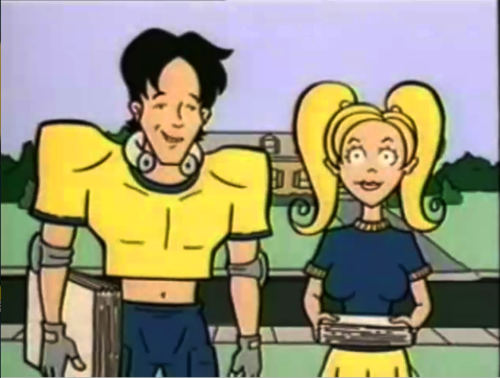
Something that distinguishes Daria from most other teen series with an "outcast"-type protagonist is the fact that the head cheerleader and football captain are not antagonists in the least.


Brittany and Kevin (truly prophetic name choices there, I might add) may be utter dunces, but they're not mean or unpleasant. They are always friendly to Daria and Jane, and Brittany even does her best to do poor unpopular Daria a favour by inviting her to a house party in one of the series' first episodes. Daria and Jane, by contrast, kind of look like total assholes, as they mock Brittany and Kevin constantly, sometimes to their faces, when all the couple try to do is be friendly and sweet.

It's easy to understand why Daria and Jane behave this way, of course, because they're teenagers who have not developed fully evolved critical thinking skills, and as intelligent as they may be, they don't have the maturity to see that they would get along in high school much easier if they just accepted the friendship of the "popular kids", since it is genuinely offered without expectations.

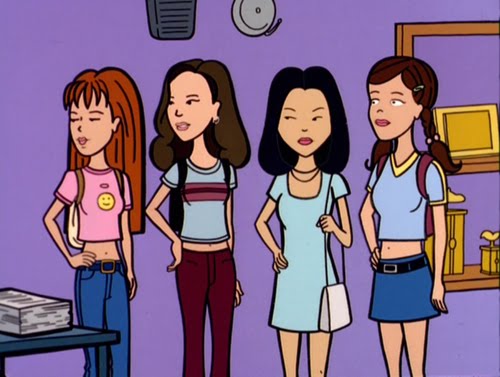
If the pair have any true antagonists at school, it's probably Sandi and the other members of the Fashion Club.


Quinn and Stacy are less antagonistic than Sandi and Tiffani, but since they encourage the other girls' behaviour and enable their bullying, I'm going to say they come close. What's ironic about the Fashion Club though is that they are just as rude and snobby as Daria and Jane, albiet in a very different way. Daria and Jane are unpleasant because they feel disenfranchised and unnoticed in the "girl culture" of the '90s, and the fashion club are unpleasant because they feel intimidated by their more intelligent peers with the looming threat of college on the horizon.

Both groups of kids have their own issues to deal with, and I think the series explores this idea as Quinn grows emotionally throughout the run of the series, choosing to expand her horizons beyond sartorial choices, while Daria eventually gains some confidence and manages to develop enough self-actualization to participate in a real relationship with a human male.

In that sense, I think Daria is like The Breakfast Club in that it explores the hidden depths of every high school stereotype, from Brittany the Bimbo to Daria the Brain, to Sandi the Bitch and Jodie the Token Minority (there's been great stuff written about her, which as a white woman I don't feel qualified to regurgitate). 

So: is Daria an appropriate heroine for nerdy teenage girls? Someone they should emulate? It's hard to say. On the one hand I would answer no because she's deeply insecure and takes that out on other people. On the other hand, I think she experiences significant growth throughout the length of the series, and perhaps she could serve as an example of moving on from one's bitterness and self-hatred. In any case, I think the series itself is something that disenfranchised teenagers will always take comfort in, because it reassures them that there are other kids out there like them, and perhaps it will give them hope that they too can move on from a stifling environment to become fulfilled and feel appreciated, like Daria seemed to be in her last appearance, the TV movie Is It College Yet?.