Showing posts with label television. Show all posts

Tuesday, 17 June 2014

Shelly Johnson is the unsung heroine of Twin Peaks

Trigger warning: this entry contains discussions of sexual abuse, spousal abuse, and child abuse.

When I talk about Twin Peaks, I always feel it necessary to mention that my fascination and obsession with the show lies much deeper than a regard for its moody aesthetics or an appreciation for  David Lynch as a director (although I very much appreciate David Lynch). For me, it is more than just a TV show and cultural icon, it is something very spiritual to me, something that speaks to the dark places of my soul that I thought nothing could ever penetrate.

Twin Peaks is often name-dropped by mainstream media and bloggers as a quirky supernatural detective show, an interesting piece of '90s ephemera, while its more significant themes of abuse and incest are largely ignored in favour of references to cherry pie and saddle shoes. It's not that I mean to be pretentious, as if I'm the only one who loves the show for its dark themes and connects with it emotionally, because many women in the fandom do, but I do feel that certain aspects of the show are overrepresented while other elements of the show (as well as important and meaningful characters) are largely ignored.

With that in mind, I'd like to devote some time to arguably my favourite character in the series, waitress Shelly Johnson.


Unlike the other ladies of Twin Peaks, not much of Shelly's backstory is explicitly stated, other than that she dropped out of high school to marry truck-driver Leo. However, there is much we can infer about her life based on context and clues given by the show and tie-in materials. 

At the time we are introduced to Shelly, she is 19 years old, and she states that she dropped out of eleventh grade to marry Leo, which means that she has been married to him for at least two years. She works at the Double R Diner as a waitress and seems to be friends with the proprietor Norma (who, at 35 or so, plays somewhat of a maternal role towards Shelly).

The biggest question about Shelly seems to be "why is she so alone?". Her parents or any sort of family are never mentioned and she doesn't seem to have anywhere to go to get away from Leo's abuse. She also seems to lack any of the resources that she would need to escape from him: she doesn't have any money of her own (likely because Leo takes all her earnings from the diner) and she also seems to lack a lot of adult life skills, like driving.

None of this seems coincidental to me. I think it is indicative of a history of parental abuse for Shelly. It's important to think about the context here: what would be going on in Shelly's everyday life that would lead to her dropping out of school and moving out to marry a truck driver? Why else would anyone be so desperate to get out of their parents' house? Of course, the sad irony is that because Shelly probably grew up in an abusive household, she would be unlikely to recognize the red flags and warning signs of abusive behaviour in Leo, as she would have become so accustomed to abuse at home that she wouldn't be able to recognize what wasn't normal.

It seems to me that Shelly has known abuse all her life, and that she is not so dissimilar from her deceased peer, Laura Palmer. Shelly is 19, Laura was 17- they would have passed each other in the halls at school before Shelly dropped out, and they knew each other from volunteering from Meals on Wheels. They were both abuse victims and were both involved with Leo Johnson. 

It's clear that Leo intended to murder Shelly when when he tied her up and set the mill on fire, and I have to wonder- would Shelly's death elicit as much mourning and sympathy as Laura's? I doubt it. Everyone in town knew Laura, and everyone knew Shelly too, but in a different context. And that context is what makes the difference. Shelly is "white trash"- a girl from the Wrong Side Of Town who dropped out of high school to marry a truck driver and work as a waitress. It's clear from contextual evidence that the townspeople, even Sheriff Truman, knew that Leo was beating Shelly (and probably raping her too) but no one did anything about it, not even Bobby, who is supposed to care about her. Nobody even offered her a place to stay.

I guess it makes sense for the sake of the narrative, but my heart goes out to Shelly. She's a sweet, adorable girl with a loving heart who makes great pies. She deserves just as much concern and sympathy as any other abuse victim, but she will never get it, because of her class status. I think that's often the way of life though.

I don't mean to lessen Laura's suffering or say that Shelly deserves more sympathy than her, because Twin Peaks is largely a series about the different forms abuse may take and the way it affects all kinds of women (Laura, Shelly, Audrey, Josie, and even Norma to an extent). It's about how nobody deserves abuse no matter if they're a "Bad Girl" or a "Good Girl". I just wish that people paid more attention to this aspect of the show and Shelly's storyline when discussing the themes present in Twin Peaks. 


Wednesday, 28 May 2014

Mental Illness Narratives in Media

As someone who is both mentally ill and a vociferous consumer of popular media, it's rare for me to see a movie or TV show that accurately reflects the struggles an individual deals with when dealing with mental illness. There have been some novels written by authors who also suffer from mental illness, but by and large I have found that most media representation of the mentally ill is inaccurate, unsympathetic, and sometimes downright harmful.

Classic literature has a long history of authors writing frankly about their mental illness, even if it was in antiquated terms: Ernest Hemingway, Virginia Woolf, Sylvia Plath. But since film and television are far less personal mediums than literature, they tend to use mental illness as a plot device or an interesting character trait rather than offering a first-person account of mental illness. This is dangerous for several reasons. The first being that film and television are two of the most accessible forms of popular media, and are available to people who may not be blessed with the education level or resources needed to access classic literature and/or academic writing. This means that for many people, their entire understanding of mental illness is based on what they've seen in films and on television. Those who suffer from mental illness but haven't been diagnosed may know that there is something wrong with them, but struggle to identify with the often outrageous and outlandish depictions of mentally ill people that they've seen, and so remain undiagnosed and unable to seek help. Those who do not suffer from mental illness may have seen Jeremy Sisto as Billy Chenowith on Six Feet Under or Glenn Close as Alex Forrest in Fatal Attraction and assume that these are accurate depictions of bipolar disorder, and become fearful of schizophrenic or borderline people. Or it may not be as bad as that: maybe they've seen Silver Linings Playbook and think they understand bipolar disorder, think that their bipolar friend's problems can be solved if they just set them up with some young hottie who likes to dance. Oh, if only it were that easy! The entire psychiatric community would be out of work.

As someone who suffers from depression and is a recovering bulimic, I find it difficult to relate with the characters in film and television who are explicitly stated to be mentally ill and are supposed to represent people like me. To begin with, protagonists who are canonically defined as "depressed" are almost always white men, and usually white straight men. I think that's probably because a mentally ill character is already an "other", so the writer may try to make them as "normal" as possible in every other aspect of their characterization. Unless, of course, they're a villain, in which case they're also often coded as queer, because dangerous craziness and queerness are so often intertwined in popular media! Never mind that queer people are more likely to be depressed due to the oppression and discrimination they face every day- most Crazy Queer Villains are depicted as madmen and madwomen, driven to homicidal insanity by their sexual perversions. This is a trope that was once extremely prevalent and seen everywhere from psychodramas and thrillers to animated children's movies (think: Professor Ratigan from The Great Mouse Detective, coded "sissy" and violently insane). It is slowly falling out of favour, but it can still be found in popular procedural crime shows like CSI and Criminal Minds.

Even when characters aren't portrayed as villains, they are often written and acted very stereotypically and one-dimensionally, as both the writers and the actors choose to base their interpretation of a mentally ill character on a set of symptoms, rather than portraying their character as a fully-realized person with interests and quirks that exist outside of and irrelative of their mental illness. Personally, I've done a lot of research into the way eating disorders are portrayed in media aimed at teenagers, and I've found that the characters are almost always stereotypical Type-A "Best Little Girl In the World" overachievers. I'm thinking here of endless Young Adult novels, a recent storyline on Glee, and that time on Lizzie McGuire that Miranda stopped eating for one episode but was cured after a pep-talk with her friends. In most teen media in fact, eating disorders are portrayed as a confidence issue that can be cured easily (I could wrte another entire post on how this erases the very real struggles of eating disordered people, who are overwhelmingly girls and women). To my mind, the most well-rounded and developed character with an eating disorder storyline to date has been Cassie Ainsworth from the British teen drama Skins. She has anorexia, and it is a continual struggle for her, but she has character traits that are not related to or attributed to anorexia, a love interest, and is generally quite sympathetic and likeable. When I was at my worst suffering from my own eating disorder, my best friend watched Cassie's episode of Skins and said it helped her to understand me better.

And that's the thing about proper representation: it doesn't have to get in the way of a good story. Cassie's storyline is engaging and interesting even to people who don't have anorexia or bulimia. It's entertaining, but not damaging. The same can be said for the many mentally ill characters on Mad Men (though I'm still waiting to see how Ginsberg's schizophrenia storyline plays out).

All I want is to see people like me onscreen. People who aren't dangerous, or hopeless, or inhuman... just... whole. Because mentally ill people like me aren't broken or incomplete or irreparable, we just want to be understood.


Tuesday, 6 May 2014

Mad Men, or, "Daddy Issues: The TV Show"

So the theme of paternal abandonment continues, both in my life and on Sunday's episode of Mad Men! But, as per the theme of this blog, I'm going to stick to covering Mad Men, with this entry paying particular focus on the interaction between Roger Sterling and his daughter Margaret.

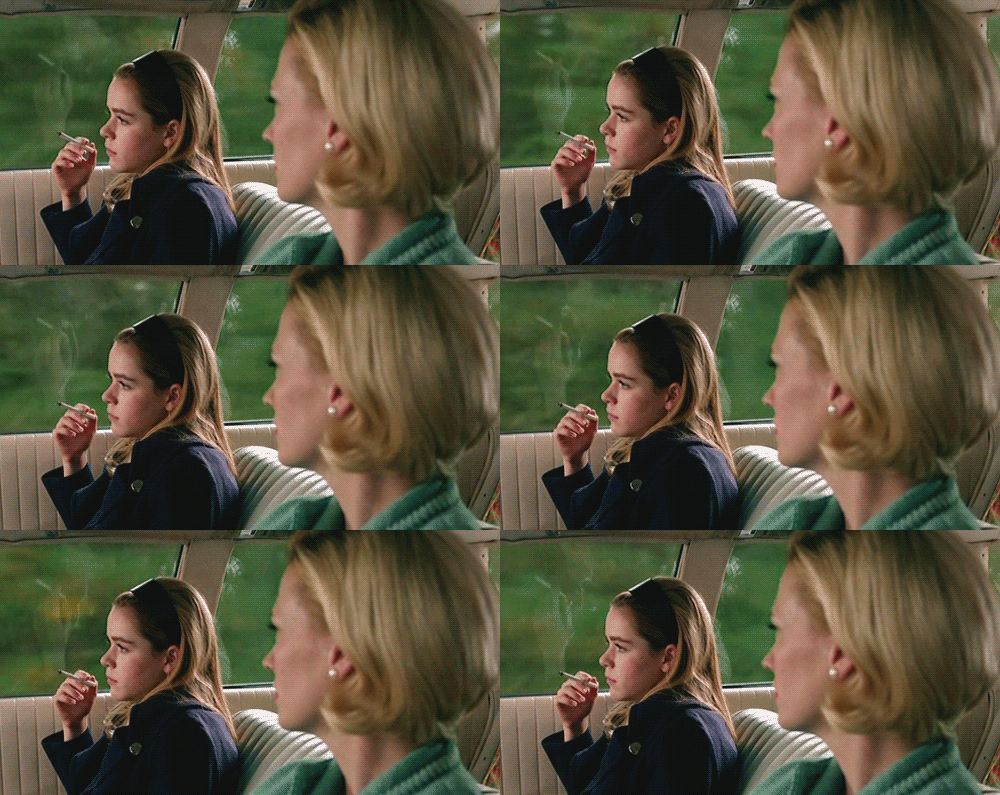
Margaret is an interesting character in that the events of her life are rarely shown through her perspective on the show. Instead they are mostly relayed to us by Roger through conversations he has with other characters. In an early episode, Roger bitches to Joan about the fact that Margaret seems to have no motivations in life, only having dated two boys (one who committed suicide). You'd think that even someone like Roger would be able to extend sympathy to Margaret for dealing with a tragedy like that, but the event is reduced to pillow talk between him and Joan (Joan, lovely Joan, defends Margaret, saying that Roger is too hard on him). In another episode, Margaret's possible eating disorder is hinted at as Roger jokes that Mona stopped cooking after Margaret stopped eating.

And of course, there is Margaret's wedding, the events of which are particularly contentious for father and daughter as Roger is hell-bent on taking his new, much younger wife Jane to the wedding, while Margaret is against this. It's not a huge leap to assume that Margaret is viciously (and rightfully) jealous of Jane for her relationship with Roger. After all, Jane is not much older than Margaret herself.

So as we can see Roger and Margaret have quite the strained relationship, largely due to Roger's failure to provide for Margaret emotionally and to acknowledge her humanity as a daughter. I think this has much to do with Roger's issues with women: he tends to categorize his relationships with women as either sexual and passionate or cordial and distant. For instance, he doesn't appear to have much regard for Peggy as a friend or colleague despite seemingly respecting her work.

Roger doesn't know quite what do do with Margaret, a daughter, because he never wanted a daughter. A son, he could commiserate with and raise in his own image, but with Margaret he's faced with a dilemma: does raise her to be used by men the way he uses women, or does he warn her against such men, which would require some reflection on his part and admittance to misdeeds? The answer that he comes to, of course, is neither. He chooses to give up on parenting Margaret entirely.

Which brings us then to the events of The Monolith, where we learn that Margaret has engaged in her own form of parental abandonment: leaving her toddler behind as she chooses to follow a group of hippies to live on a commune. Both Roger and Mona are shocked and make it their mission to set Margaret straight, travelling to the commune to shake some sense into her, as it were. It doesn't work, obviously, because who would want to leave a life of free love and drugs to go back to New York City with their parents, to raise a child just the same way as their parents did (and have the child grow up to be as miserable and dissatisfied as them?).

It is then we see Roger trying to take on the Cool Dad role: Oh sure I'll have a look around! Yeah, I wanna here all about your cool new life! Far too late to make a difference, of course. And as the day wears on, the similarities between Margaret and the hippie girl that Roger has been sleeping with over the course of the season become too apparent for Roger, and he's faced with the harsh reality of what he's done to the women in his relationships (the "she's somebody's daughter!" dilemma) and what a shitty human being he is towards women. His breaking point comes when Margaret sneaks off from the barn where she is supposed to be sharing a tender moment with her father, to have sex with another one of the hippies, which hits way too close to home for serial womanizer Roger.

Roger doesn't want Margaret to continue the cycle of parental abandonment that he has been perpetuating, and so he flips his shit, attempts to drag her out of there, and lays a guilt trip on her about her responsibilities as a mother. Then, Margaret, in what I can only say is one of the best fictional daughter-to-father fights I've ever heard, truly rips into Roger, handing his ass to him about his own parental abandonment and all-around shitty behaviour as a father.

Roger mocks Margaret (Marigold) about her life in the commune, telling her she's got to step up and face reality, be a mother and stop living for a life of hedonistic pleasure.... but isn't that exactly what Roger did for Margaret's entire childhood? Boozing it up, banging secretaries, spending loads of money and basically doing whatever he wanted? Margaret is clearly still extremely bitter over what she feels was a shitty childhood and she unloads it all on her father, so viciously and so painfully: "How did you feel when you went away to work, Daddy? Your conscience must have been eating you alive. Calling your secretary from a hotel at lunch to pick out a birthday present for me.... it's not that hard, Daddy, I'll be fine."

Roger walks away in his muddied suit, defeated.

The events of Roger's trip to the commune echo Don's own relationship with Sally and perhaps serve as a warning of sorts as to what will happen if Don doesn't get his shit together and be a proper parent. What pains me so much though is that this episode is set in 1969 and there are still girls and women out there with the same complaints about their fathers: they never cared, they were never there, they never had any emotional connection. People like to say that about Mad Men: "oh, weren't things terrible back then?",  they say, but things are still pretty terrible, just not as explicitly. When will they get better? When men like Roger and Don everywhere start getting their damn shit together.


Sunday, 20 April 2014

On "Frasier", Accents, and Class Distinctions

In a discussion about class, regional accents, and the way they are presented on television (especially American television)  the most pertinent example, for me anyway, would be Frasier Crane of Cheers and later his eponymous sitcom Frasier.

Frasier Crane is initially introduced in Cheers as a love interest to Diane. He is a haughty, uptight, somewhat pretentious psychiatrist intended as a foil to Sam's 'jus-plain-folks' working-class persona. He was pompous, overbearing, and full of himself, and was not the most popular character on Cheers. As Kelsey Grammar has frequently mentioned, he was often approached during his run on Cheers by fans of the show who would ask "are you that pin dick that plays Frasier on Cheers"? Frasier's Mid-Atlantic accent is supposed to indicate that he is a man of 'good breeding', so to speak, making him removed from his friends at the bar, who are all regular working stiffs from families of working stiffs.

While the Frasier character began life as a typical unflattering upper-middle class stereotype (over-educated, boring, coded feminine, and a distinct clipped and affected upper-middle class neutral American accent) the transition from Cheers to Frasier allowed the audience to see a different side to Frasier following his divorce from his equally chilly and uptight wife Lilith. Namely, the introduction of Frasier's father Martin, a retired cop. While Frasier claimed to be the orphan son of a scientist father in Cheers, it is revealed that he in fact has distinctly working-class origins, as Martin has nothing of Frasier's mannerisms, nor anything close to his accent. (As an interesting note, John Mahoney, who plays Martin Crane, is a British expat who was raised in Blackpool by a family of Mancunians.).

As an audience, we come to learn that Frasier has adopted his upper-middle class persona and his pompous attitude as a defense mechanism against the bullying he endured as a child and as a sort of rebellion against his cop father. He chose to remove himself from his father as much as possible, in order to escape his roots and be better accepted in the world of academia and psychiatry. However,  the living situation that is thrust upon him (taking his father in after an injury reduces Martin's mobility) forces him to accept the reality of his origins. The humour of the show often derives from the conflict that arises between Frasier and Niles and their attempts to be taken more seriously in their fields, alongside their father's lack of pretension and his propensity to foil their social-climbing schemes.

Then we throw Daphne Moon in the mix, who is identifiably working-class as she has a thick pseudo- Manchester accent and often speaks of her formative years in England in a less-than-pretentious way. Daphne and Martin bond over their working-class backgrounds, while Frasier often scoffs at Daphne's tales of childhood or claims of psychic abilities. Niles' infatuation and eventual relationship with Daphne could perhaps be attributed to a desire to re-claim his working-class identity or a way of reconciling what he may view as abandonment of his father and his father's way of life.

Regardless of motivations, the Niles/Daphne relationship represents a destruction of class boundaries, as Daphne is not only identifiably working-class in her accents and mannerisms, but also her profession, because as Martin's physical therapist she could generally be regarded as "the help". For Niles to fall in love with a woman like Daphne requires an acknowledgement of these class boundaries and also an outright rejection of the class distinctions that he has spent his adult life mimicking and affecting. The same can be said for Daphne, as her "Manchester" accent is slightly mangled and Jane Leeves has said that this was intentional on her part to indicate that Daphne has spent quite some time in the States and has probably intentionally taken on a bit of an American twang in order to fit in with her peers in the USA.

It's not to say that Frasier is a perfect representation of class distinctions or that it breaks down any boundaries, as a 30-minute American sitcom. Certainly, any Brit or anyone with British ties couldn't help but laugh at the fact all of Daphne's brothers have wildly differing regional accents. All in all though, I think anyone from a working-class background who has ever struggled with their working-class identity and being accepted in a field that is not friendly to working-class people can relate.

Tuesday, 15 April 2014

"Hi, I'm Daria. Go to Hell."


Oh, Daria. There's so much to be said about this show that has, inevitably, already been discussed by legions of nerds and/or hipster ladies before me. In accordance with that fact, I hope that my thoughts on the series will offer a fresher perspective than what has already been said.

First of all, a little background, because I know you're just dying to hear the details of my childhood media consuming habits: Daria premiered in 1996, when I was six years old, ostensibly too young for the series. I don't remember exactly when I started watching the show, but it was sometime after the first few seasons had already aired, but not before the series had ended, so sometime in the late nineties. My parents were extremely strict about the television that my sister and I were allowed to watch, and we were banned from watching most mainstream cartoons. The two exceptions were The Simpsons (because it was "intellectual and satirical") and Daria, because it featured a female lead who was intelligent, interesting, and who refused to buy into shallow ideals of beauty and relationships. What can I say, my parents were feminists, and I'm lucky that they were.

As a nerdy brunette with glasses, a dysfunctional family, and a pretty, popular sister, I heavily identified with Daria at the time. I felt I was surrounded by idiots and used my wit and intelligence as a defense mechanism against my peers' attacks on what I was supposedly lacking (beauty and popularity, naturally). To have someone like her to look up to was comforting at the time, but as an adult re-watching the series, I have to question whether Daria is an intentionally flawed heroine or simply a "nerdy" version of the mean bitchy cheerleader trope.

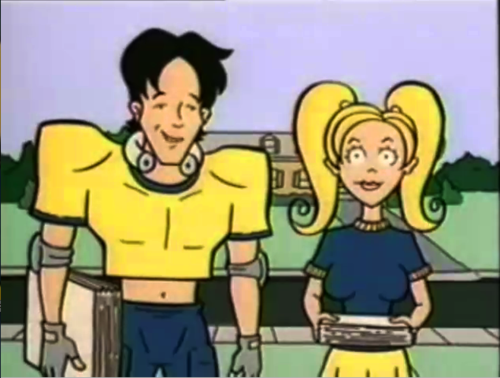
Something that distinguishes Daria from most other teen series with an "outcast"-type protagonist is the fact that the head cheerleader and football captain are not antagonists in the least.


Brittany and Kevin (truly prophetic name choices there, I might add) may be utter dunces, but they're not mean or unpleasant. They are always friendly to Daria and Jane, and Brittany even does her best to do poor unpopular Daria a favour by inviting her to a house party in one of the series' first episodes. Daria and Jane, by contrast, kind of look like total assholes, as they mock Brittany and Kevin constantly, sometimes to their faces, when all the couple try to do is be friendly and sweet.

It's easy to understand why Daria and Jane behave this way, of course, because they're teenagers who have not developed fully evolved critical thinking skills, and as intelligent as they may be, they don't have the maturity to see that they would get along in high school much easier if they just accepted the friendship of the "popular kids", since it is genuinely offered without expectations.

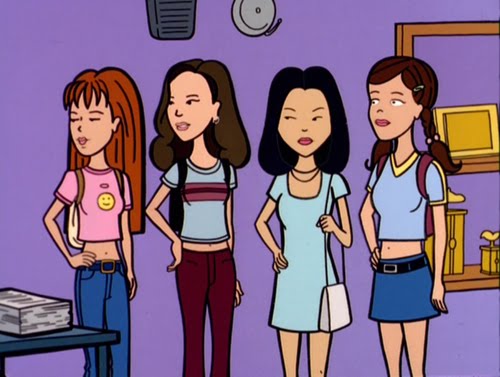
If the pair have any true antagonists at school, it's probably Sandi and the other members of the Fashion Club.


Quinn and Stacy are less antagonistic than Sandi and Tiffani, but since they encourage the other girls' behaviour and enable their bullying, I'm going to say they come close. What's ironic about the Fashion Club though is that they are just as rude and snobby as Daria and Jane, albiet in a very different way. Daria and Jane are unpleasant because they feel disenfranchised and unnoticed in the "girl culture" of the '90s, and the fashion club are unpleasant because they feel intimidated by their more intelligent peers with the looming threat of college on the horizon.

Both groups of kids have their own issues to deal with, and I think the series explores this idea as Quinn grows emotionally throughout the run of the series, choosing to expand her horizons beyond sartorial choices, while Daria eventually gains some confidence and manages to develop enough self-actualization to participate in a real relationship with a human male.

In that sense, I think Daria is like The Breakfast Club in that it explores the hidden depths of every high school stereotype, from Brittany the Bimbo to Daria the Brain, to Sandi the Bitch and Jodie the Token Minority (there's been great stuff written about her, which as a white woman I don't feel qualified to regurgitate). 

So: is Daria an appropriate heroine for nerdy teenage girls? Someone they should emulate? It's hard to say. On the one hand I would answer no because she's deeply insecure and takes that out on other people. On the other hand, I think she experiences significant growth throughout the length of the series, and perhaps she could serve as an example of moving on from one's bitterness and self-hatred. In any case, I think the series itself is something that disenfranchised teenagers will always take comfort in, because it reassures them that there are other kids out there like them, and perhaps it will give them hope that they too can move on from a stifling environment to become fulfilled and feel appreciated, like Daria seemed to be in her last appearance, the TV movie Is It College Yet?. 


Monday, 14 April 2014

On Rita Leeds and Arrested Development


Something that has always been a source of debate among Arrested Development fans is the Rita storyline and the question of whether it not it is disrespectful to mentally disabled people. Speaking strictly as someone who loves the show and has only dabbled in the fandom, I cannot say whether or not anyone from the disabled community has spoken on the storyline and whether or not is offensive. Based only on my observations as a viewer, though, I have always felt that the way the story was written was respectful to Rita specifically as a character. The true humour of the arc came not from mocking Rita's disability, but rather from highlighting what awful people the Bluths are in regards to their treatment of her.

Michael, of course, is horribly selfish from the beginning in his relationship with Rita, as he initially only approaches her in order to get her assistance in helping him view some classified documents. He becomes enchanted with Rita, but only because of her beauty, whimsical nature, and willingness to listen to him pratter on about his ridiculous problems. He knows almost nothing about Rita aside from the fact that she's British and lives with her uncle. If he had even bothered in the slightest to ask her about her life, he would have learned (as she would have offered the information gladly) that she is mega rich and mentally disabled. 

Secondly, the storyline also serves to highlight how truly awful the other Bluths are as well, as they see nothing wrong with marrying Michael off to a woman he knows absolutely nothing about (and who is terribly unsuited to him, his lifestyle, and family) because they want her family money.

I'd say that particular storyline is in a sense, part of the essence of Arrested Development, as it asks us to follow the lives of an extremely unlikeable family,  and tricks us into sympathizing with them until they do something so reprehensible that we are startled out of our comfort zone and forced to acknowledge the reality of the Bluths, and to recognize that they are people who, if we were watching their storyline unfold in real-life on the news, we would be cheering for their destruction and dissolution.


Sunday, 13 April 2014

"My Father Has Never Given Me Anything..."


Something I think about a lot as I re-watch the last season of Mad Men is Sally Draper's relationship with her parents. Up until she caught her father fucking Lindsey Weir in Elizabeth Taylor drag, she idolized him and saw him as the the Good Parent to Betty's Bad Parent. That's not to say that Betty isn't a Bad Parent, but isn't Don pretty terrible as a father too? Ditching his kids so he could move in with his new wife to a chic Manhattan apartment? Leaving them alone for the night without any supervision whatsoever? Sally doesn't see that, though, because she isn't around Don enough to realize what an asshole he truly is. She is around enough to bear the full brunt of Betty's anger and frustrations, though, and to take her abuse head-on. That's the thing, really. They're both horribly abusive parents, but Betty's abuse is just more obvious, especially to a child who grew up in a time when all TV moms were nurturing and kind and happy. It's easier to put Don's abandonment out of her mind, but Sally has to live with Betty's abuse every damn say.

It makes me wonder if children, and society in general, think of abusive mothers as much worse than absentee or neglectful fathers simply because mothers are not 'supposed' to have character flaws like the coldness, anger, and resentment that Betty has.

It's particularly sad, though, when a mother is abusive towards a daughter, because we think that as a woman, she should know how hard it is to constantly feel as if you are not good enough, and that she would not be so heartless to inflict that on a child. We expect heartlessness from men, so when a father abandons his children, it's obviously shitty but not at all surprising because men are generally pretty scummy or can turn scummy at a moment's notice.

My parents share some similarities to the Drapers, and it's difficult for me to reconcile my sympathy for Betty with my deep and abiding empathy for Sally. It's maybe more difficult to have a mother like Betty than it is to have a father like Don, because as a young woman growing up you have no understanding of what a healthy female friendship or companionship dynamic should feel like. We all joke about the 'daddy issues' that arise from paternal abandonment; but if a young woman doesn't know how to make friends that will set her straight and give her guidance in her relationships with men, what does she have?

It's also easier for people to understand or believe paternal abandonment from an outside perspective if they haven't experienced it. Based on personal experience, I have found that my friends and acquaintances don't know how to respond to and often don't even believe admissions of maternal abuse, be it emotional or physical.

Victims of abandonment or abuse should perhaps stop asking ourselves "who fucked me up the most, mom or dad", and rather ask ourselves "how fucked up am I, exactly, and how can I avoid fucking up my kids in the same way?". Easier said than done, of course, especially when paternal abandonment can have consequences that are not as obvious as abuse.

I wish there was an easier answer for all of this, but there isn't. I guess this is why therapists will always be able to find work.

Thursday, 14 March 2013

My Top Ten Favourite Simpsons Episodes


1. A Streetcar Named Marge
While this episode may not be everyone's first choice, I've always found it hilarious and touching, especially for an episode centered around Marge, who is usually the straight man of the show. As with most episodes that deal with Homer and Marge's marriage, it's rather bittersweet. I'm assuming that anyone reading this is familiar with the plot of any Classic Simpsons-era episode, so I'll refrain from summarizing the plot. However, I will say that the arc of this episode is a rare insight into Marge's sad little life and troubled, repressed psyche. Her life as a housewife is far from intellectually or artistically stimulating, and her idea of "branching out" is to audition for a hokey community theatre production. Homer is a complete asshole to her about it, and she channels her pent-up frustrations in her performance of Blanche DuBois. By the end of the episode, Homer has acknowledged that he's been neglectful of Marge's feelings. He doesn't promise to change, nor does he show any particular insight into her frustrations. It's quite sad, really. 
Aside from that, though, the writers manage to pull off an epically scathing parody of every shitty community theatre production ever, as well as musicals in general. The opening number of "Oh! Streetcar" is perhaps one of the greatest moments in the show's history. From the hilariously cutting lyrics to the needless exposition, to the giant Superdome prop that exists only to illustrate a single rhyming couplet, it's a masterpiece of parody. 
Also worth mentioning is the inspired B-plot involving Maggie which both parodies The Great Escape and skewers Ayn Rand. 

2. Last Exit to Springfield
Many have argued that "Last Exit to Springfield" is the greatest Simpsons episode ever, and I would be hard-pressed to disagree with them. In fact, I believe that if a Simpsons movie had been made in the 90s as originally planned, "Last Exit" would make the perfect feature film. I love this episode because it shows a side of Homer that is sorely lacking in recent episodes: his compassionate side and his love for his family. His motivation to lead the strike? His love for Lisa and his desire to see her get the best dental care possible.
What makes this episode truly great is its spot-on parodies of pop cultural motifs. Specifically, the spoof of "How the Grinch Stole Christmas", the "Yellow Submarine" dream sequence, and the ending, where everyone laughs collectively over a stupid pun (reminiscent of every lame '70s sitcom ever.)

3. Homer's Barbershop Quartet
As a Beatles fan, it's no wonder that this episode is among my very favourites. Of course, everyone knows that this episode is one big tribute to the Beatles and their relatively short rise and fall- but what really gets me is how nuanced the Beatles tributes are. There are, of course, easily-identifiable references to Abbey Road, "Revolution 9", and the merchandising boon that was Beatlemania. What makes this episode truly enjoyable for a Beatles aficionado is the subtle and obscure references to their career and personal lives.
"Wiggum forever, Barney never!" is a reference to a real chant from the Beatles' early days at the Cavern Club when they replaced their first drummer Pete Best with Ringo Starr. The fans chanted "Pete Best forever, Ringo never!", but as we all know, Ringo won over the Cavern Club crowd much in the same way that Barney won over the patrons of Moe's Tavern. 
The episode is nostalgic and warm without being overly fawning towards the Beatles, and manages to get a few jabs in here and there. Every time I watch it, I manage to find another hidden reference that the writers stuck in.

4. Cape Feare
Although it helps to be familiar with the film Cape Fear to get all of the jokes in this episode, it isn't necessary in order to enjoy it. I loved this episode as a kid long before I had seen the movie or had any idea what the show was referencing. Regardless, I believe "Cape Feare" to be some of the finest television ever broadcast. It's a fantastic piece of writing, animation, editing, and voice acting and an all-around gem.
What I really love about "Cape Feare" isn't the all-around plot so much as some of its excellent throwaway gags and one-liners. Every time I see Santa's Little Helper tied up at the dock, swimming around in a circle, I bust a gut laughing, and the "Homer Thompson" routine never, ever, gets old. Ditto for the "Sideshow Bob steps on rakes" scene, which is often cut in syndication, losing most of its appeal. This episode is perfectly paced and full of plenty of action and excitement. It's fast-moving, features the incredible voice talents of Kelsey Grammer (who, as time goes on, seems to resemble Sideshow Bob much more than Fraiser Crane, personality-wise), and, most incredibly of all,  includes an amazing and hilarious tribute to Gilbert and Sullivan- hardly typical fare for a primetime Fox comedy in the 1990s. I'm trying my absolute best not to just parrot my favourite lines from these episodes, but I JUST have to say- "BARTYOUWANNASEEMYNEWCHAINSAWANDHOCKEYMASK?"

5. Lisa's Wedding
Unsurprisingly, I'm quite a big Lisa fan. What can I say? For a little growing up in the '90s as a bookish outcast, she was a role model for me. She made me feel like I wasn't alone in the world. As a 22-year-old today, I still relate to her in almost every way, and this episode speaks volumes to me.
Lisa fell in love with Hugh because he represented to her, the intellectual elitism that she had been idealizing and chasing her entire life. He was charming, British, and respected her for her brains. And yet, he revealed his true colours when he refused to even humour poor Homer, who was, after all, doing his very best to welcome Hugh into the family. 
Love can be so incredibly painful, especially for people like Lisa and me, who grew up insecure and unsure of our place in the world. When someone comes along and assures you that you've been right all along, that you really are better than everyone else, it can be thrilling... for a while. After some time, you realize that as much as you disparage your roots, they still made you what you are today, and you can't turn your back on them.
I guess this is one of those episodes that I like more for the emotional resonance than the jokes and gags. Lisa episodes tend to strike a very melancholy chord with me, for although they suggest that Lisa will eventually find a better life beyond Evergreen Terrace, they also give the impression that she will always be an outsider and just a tad dissatisfied.

6. King-Size Homer
This is probably the only Homer-centric episode on the list. I don't want to seem as if I don't like Homer. He's a great character who manages to be sympathetic even when his motives (as in this particular episode) are rather selfish. I think this is probably because Homer, as a character, though he may be buffoonish and slightly ill-mannered, still has an intrinsic human characteristic that a great many of us share: the desire to be liked and accepted. In the hands of less skilled writers, "King-Size Homer" could turn into one long, cruel fat joke. Instead, it turns into a treatise on both acceptance of others and pride in oneself. The episode also includes some of my favourite jokes, including Homer's ineptitude with a home computer, and Ralph's classic, "I heard your dad went into a restaurant and ate everything in the restaurant and they had to close the restaurant." 

7. Lisa's Substitute
Another Lisa episode! And this one with Dustin Hoffman, one of my celebrity crushes (it's those Semitic good looks). As a Lisa fan, I find her episodes are most often the most emotionally poignant, and I enjoy the way the show explores her relationship with Homer. "Lisa's Substitute" is an episode about a schoolgirl crush (and I can certainly relate to that) but it is also an episode about a father and daughter struggling to relate to each other (I can relate to that too). 
While the show's writers often use Lisa as a mouthpiece to spout liberal rhetoric, I find her most compelling and effective when she acts like an eight-year-old girl. For although she has intellect far beyond her years, she also has the naiveté and enthusiasm of the young girl that she is. Her adorable crush on Mr. Bergstrom, her embarrassment over her father, and her eagerness to prove herself are all typical traits of a child her age. 
The episode ends on a bittersweet note, again with the suggestion that there is a better life for Lisa, but also again with the knowledge that she still has a long way to go. You know, the more I think about it the more I reckon I'll have to devote an entire post to Lisa as a character. She's so relatable and sympathetic to me. 

8. Rosebud
"Oooh, a head bag. Those are chock full of... heady goodness."
That quote is just one of many reasons to love "Rosebud".  Although the episode is ostensibly a parody of Orson Welles' classic Citizen Kane, like "Cape Feare", you needn't have watched the movie to enjoy the episode, because it's more than just a parody. Like Citizen Kane, it's a commentary on capitalism, ruthlessness, and the drive to succeed that makes us neglect the things in life that make us more happy than money ever could.
Mr. Burns is, at times, an over-the-top caricature of megalomaniac villains, so it's nice to see his human side once in a while, as in this episode. Although he's put Homer, the family, his employees, and the citizens of Springfield through some hellish bullshit, he still manages to evoke a tiny bit of sympathy in this episode. Perhaps because Mr. Burns is an example of the American dream taken to extremes. He's only done what society has drilled into our heads as the ultimate accomplishment- become filthy stinking rich. And, like William Hearst (who Citizen Kane was based upon) or his modern-day equivalent Donald Trump, he's become a shell of a man, unhappy in the very thing that he believed would finally bring him satisfaction.
Aside from the social commentary, this episode also has some brilliant one-liners and sight gags, including the very final scene set in the future featuring Mr. Burns as a preserved head in a jar, which Matt Groening cites as his inspiration for Futurama.
It's hard to say anything about "Rosebud" that hasn't already been said better at snpp.com or in a Popular Culture Studies term paper, but the episode stands as a golden moment for the Simpsons and television in general.

9. Marge Vs. The Monorail
You know how some people still mourn Heath Ledger's death and watch all his movies on the anniversary of his passing? And upload gifsets to Tumblr with profound quotes? That's how I feel about Phil Hartman.
"Marge vs. The Monorail" is a fantastic episode all around, but what makes it truly great is Phil Hartman's inspired performance as old-fashioned shyster Lyle Lanley. In a plot clearly heavily influenced by The Music Man, Lanley convinces the townspeople of Springfield to build a monorail with a surplus of money they've recent;y come into. This being the Simpsons, of course, his intentions are far from honourable and he builds a slipshod monorail, planning to run off with the profits. I'm sure you've all seen this episode so there's no need to go into what happens. But this episode blends the humanistic comedy that the Simpsons became famous for with the wacky plots that they would later be defined by. Some of the humour in this episode is just so out-there- (the guest appearance by Leonard Nimoy, the "scientist" that Marge meets)- that it comes as no surprise that this episode was penned by Conan O'Brien, who at the time was just a promising young upstart.
"Marge vs. The Monorail" is a perfect distillation of everything that's great about Golden Age-era Simpsons. If you know somebody who has yet to be introduced to the series, I recommend this episode.

10. Krusty Gets Kancelled
I have a huge fascination with fame and stardom, so this episode makes my top ten list not only because of the numerous celebrity cameos, but also because of the way it serves as a biting satire on flash-in-the-pan celebrities like Gabbo and longtime showbusiness schmucks like Krusty.
Krusty the Klown is an unusual character because he represents not only bored, tired children's entertainers of yore, but also classic superstars and their seemingly neverending careers. This episode in particular seemed to follow the Elvis Presley model. Like Elvis, Krusty was pushed aside for newer, hipper acts, became depressed and overweight, but managed to make a comeback with a huge, well-received TV special (the episode even references Elvis' '68 Comeback Special almost directly when we see Krusty's name lit up behind him in huge lights).
Of course, I'm also totally on board for all the great celebrity guest stars, in particular Elizabeth Taylor, whose cameo was short but sweet and surprisingly self-deprecating, and Bette Midler, whose cameo makes me want to shout "I'll get you for this Midlerrrrrrrrr!" every time I see her anywhere else.
All in all, this episode is the perfect send-up of what it means to be a celebrity constantly clawing their way up back to the top. Later-season episodes pander to the celebrity guest stars so much more than this episode did, and it's refreshing to see huge stars like The Red Hot Chili Peppers and Luke Perry (well, huge at the time) take the piss out of themselves.

Monday, 11 March 2013

Give Betty Draper Some Respect

If you are a member of the Mad Men fandom, you're no doubt aware that Betty, Don's first wife, is by far the most polarizing character on the entire series. But why, though? Although Betty is a deeply flawed individual- childish, petulant, and self-absorbed -she's no worse than Don, Pete Campbell, or any of the other male characters on the series. And despite her glacial exterior, she shows a great deal of depth.

I first want to address the complaint that I most often hear about Betty, which is that she's useless. "She's just a housewife," you say "and she doesn't even really raise her kids". The part about raising her kids, that's true. There's no denying that Betty's a shitty mother. But that's probably because she never wanted or intended to be one.

Consider Betty's history before she met Don. She was a well-brought-up young woman, and educated too. They didn't just hand out archeology degrees to young women back in the 1950s, you know. As a college graduate, Betty would have had to have fought tooth and nail against her male colleagues to get even a fraction of the respect she deserved from her professors.

And then you have her modelling career, which is how she met Don. She lived an incredibly glamourous life, travelling around the world, modelling haute couture, and hobnobbing with important people.

It's no surprise, then, that Dick Whitman was attracted to her, for she represented everything that he fetishized about America. Young, beautiful, accomplished, and well-to-do, Betty is the perfect Nordic model of the perfect American woman.

And yet.

Her marriage to Don completely sucked the life out of Betty. Everything that made her interesting and unique, like her degree, modelling career, and ability to speak Italian, was rendered completely useless in her life with Don Draper. Stuck inside a house all day, raising two kids that she never wanted by a husband who won't even let her wear a bikini... is it any wonder that Betty became bitter and cynical. And then, to find out that the man she gave up her entire life for was vicariously screwing around on her? Can you imagine how heartbreaking that must have been?

Betty is so sad that she confides in creepy nine-year-old Glen. That's how fucking miserable her life is.

Of course, there was no way that Betty could have gone back to her previous life after she got her divorce from Don, so she did the only logical thing to do, which was to remarry. But she was dissatisfied in that life, too, because as a woman in her 30s with two children... well, that's all she really is to anyone else.  Women today can't relate to that, because we can re-start our careers well into our thirties, go back to school, and become new people. But for women in the 1960s, that just wasn't an option.

The problem with judging Betty for her selfishness and poor parenting skills is that it assumes that she has access to resources and information which could help her become a better person, but she doesn't. She doesn't have a reliable parental figure, she doesn't have any real friends, and even her psychiatrist from Season One was reporting back to her husband.

I think a lot of people saw Betty's potential at the beginning of the series and wanted her to cast of the shackles of the patriarchy, pick up a copy of The Feminine Mystique, and become liberated. But the truth is, that wasn't a reality for most women in Betty's situation during that time period. They had to soldier through life without much to hope for or to believe in except for what their mothers taught them about husbands and housekeeping and child-rearing. Betty didn't have the luck or the ambition that Peggy and Joan had. She may have dug her own grave, but the patriarchy threw her in.