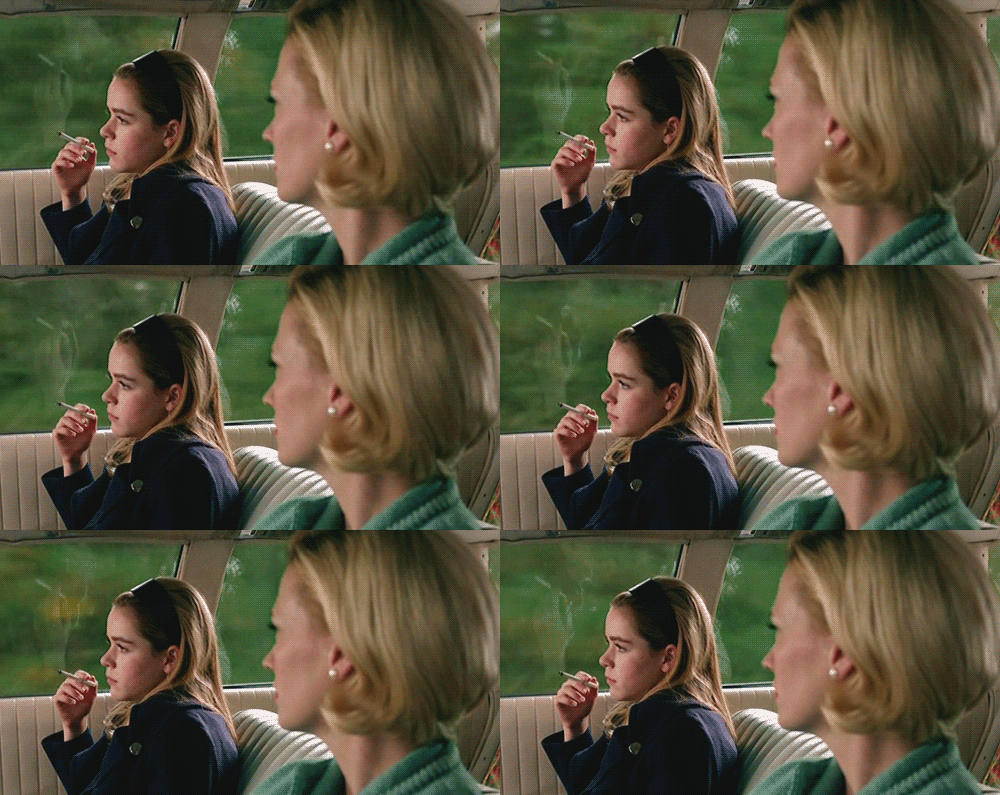
So the theme of paternal abandonment continues, both in my life and on Sunday's episode of Mad Men! But, as per the theme of this blog, I'm going to stick to covering Mad Men, with this entry paying particular focus on the interaction between Roger Sterling and his daughter Margaret.
Margaret is an interesting character in that the events of her life are rarely shown through her perspective on the show. Instead they are mostly relayed to us by Roger through conversations he has with other characters. In an early episode, Roger bitches to Joan about the fact that Margaret seems to have no motivations in life, only having dated two boys (one who committed suicide). You'd think that even someone like Roger would be able to extend sympathy to Margaret for dealing with a tragedy like that, but the event is reduced to pillow talk between him and Joan (Joan, lovely Joan, defends Margaret, saying that Roger is too hard on him). In another episode, Margaret's possible eating disorder is hinted at as Roger jokes that Mona stopped cooking after Margaret stopped eating.
And of course, there is Margaret's wedding, the events of which are particularly contentious for father and daughter as Roger is hell-bent on taking his new, much younger wife Jane to the wedding, while Margaret is against this. It's not a huge leap to assume that Margaret is viciously (and rightfully) jealous of Jane for her relationship with Roger. After all, Jane is not much older than Margaret herself.
So as we can see Roger and Margaret have quite the strained relationship, largely due to Roger's failure to provide for Margaret emotionally and to acknowledge her humanity as a daughter. I think this has much to do with Roger's issues with women: he tends to categorize his relationships with women as either sexual and passionate or cordial and distant. For instance, he doesn't appear to have much regard for Peggy as a friend or colleague despite seemingly respecting her work.
Roger doesn't know quite what do do with Margaret, a daughter, because he never wanted a daughter. A son, he could commiserate with and raise in his own image, but with Margaret he's faced with a dilemma: does raise her to be used by men the way he uses women, or does he warn her against such men, which would require some reflection on his part and admittance to misdeeds? The answer that he comes to, of course, is neither. He chooses to give up on parenting Margaret entirely.
Which brings us then to the events of The Monolith, where we learn that Margaret has engaged in her own form of parental abandonment: leaving her toddler behind as she chooses to follow a group of hippies to live on a commune. Both Roger and Mona are shocked and make it their mission to set Margaret straight, travelling to the commune to shake some sense into her, as it were. It doesn't work, obviously, because who would want to leave a life of free love and drugs to go back to New York City with their parents, to raise a child just the same way as their parents did (and have the child grow up to be as miserable and dissatisfied as them?).
It is then we see Roger trying to take on the Cool Dad role: Oh sure I'll have a look around! Yeah, I wanna here all about your cool new life! Far too late to make a difference, of course. And as the day wears on, the similarities between Margaret and the hippie girl that Roger has been sleeping with over the course of the season become too apparent for Roger, and he's faced with the harsh reality of what he's done to the women in his relationships (the "she's somebody's daughter!" dilemma) and what a shitty human being he is towards women. His breaking point comes when Margaret sneaks off from the barn where she is supposed to be sharing a tender moment with her father, to have sex with another one of the hippies, which hits way too close to home for serial womanizer Roger.
Roger doesn't want Margaret to continue the cycle of parental abandonment that he has been perpetuating, and so he flips his shit, attempts to drag her out of there, and lays a guilt trip on her about her responsibilities as a mother. Then, Margaret, in what I can only say is one of the best fictional daughter-to-father fights I've ever heard, truly rips into Roger, handing his ass to him about his own parental abandonment and all-around shitty behaviour as a father.
Roger mocks Margaret (Marigold) about her life in the commune, telling her she's got to step up and face reality, be a mother and stop living for a life of hedonistic pleasure.... but isn't that exactly what Roger did for Margaret's entire childhood? Boozing it up, banging secretaries, spending loads of money and basically doing whatever he wanted? Margaret is clearly still extremely bitter over what she feels was a shitty childhood and she unloads it all on her father, so viciously and so painfully: "How did you feel when you went away to work, Daddy? Your conscience must have been eating you alive. Calling your secretary from a hotel at lunch to pick out a birthday present for me.... it's not that hard, Daddy, I'll be fine."
Roger walks away in his muddied suit, defeated.
The events of Roger's trip to the commune echo Don's own relationship with Sally and perhaps serve as a warning of sorts as to what will happen if Don doesn't get his shit together and be a proper parent. What pains me so much though is that this episode is set in 1969 and there are still girls and women out there with the same complaints about their fathers: they never cared, they were never there, they never had any emotional connection. People like to say that about Mad Men: "oh, weren't things terrible back then?", they say, but things are still pretty terrible, just not as explicitly. When will they get better? When men like Roger and Don everywhere start getting their damn shit together.
Showing posts with label Mad Men. Show all posts
Tuesday, 6 May 2014
Sunday, 13 April 2014
"My Father Has Never Given Me Anything..."
Something I think about a lot as I re-watch the last season of Mad Men is Sally Draper's relationship with her parents. Up until she caught her father fucking Lindsey Weir in Elizabeth Taylor drag, she idolized him and saw him as the the Good Parent to Betty's Bad Parent. That's not to say that Betty isn't a Bad Parent, but isn't Don pretty terrible as a father too? Ditching his kids so he could move in with his new wife to a chic Manhattan apartment? Leaving them alone for the night without any supervision whatsoever? Sally doesn't see that, though, because she isn't around Don enough to realize what an asshole he truly is. She is around enough to bear the full brunt of Betty's anger and frustrations, though, and to take her abuse head-on. That's the thing, really. They're both horribly abusive parents, but Betty's abuse is just more obvious, especially to a child who grew up in a time when all TV moms were nurturing and kind and happy. It's easier to put Don's abandonment out of her mind, but Sally has to live with Betty's abuse every damn say.
It makes me wonder if children, and society in general, think of abusive mothers as much worse than absentee or neglectful fathers simply because mothers are not 'supposed' to have character flaws like the coldness, anger, and resentment that Betty has.
It's particularly sad, though, when a mother is abusive towards a daughter, because we think that as a woman, she should know how hard it is to constantly feel as if you are not good enough, and that she would not be so heartless to inflict that on a child. We expect heartlessness from men, so when a father abandons his children, it's obviously shitty but not at all surprising because men are generally pretty scummy or can turn scummy at a moment's notice.
My parents share some similarities to the Drapers, and it's difficult for me to reconcile my sympathy for Betty with my deep and abiding empathy for Sally. It's maybe more difficult to have a mother like Betty than it is to have a father like Don, because as a young woman growing up you have no understanding of what a healthy female friendship or companionship dynamic should feel like. We all joke about the 'daddy issues' that arise from paternal abandonment; but if a young woman doesn't know how to make friends that will set her straight and give her guidance in her relationships with men, what does she have?
It's also easier for people to understand or believe paternal abandonment from an outside perspective if they haven't experienced it. Based on personal experience, I have found that my friends and acquaintances don't know how to respond to and often don't even believe admissions of maternal abuse, be it emotional or physical.
Victims of abandonment or abuse should perhaps stop asking ourselves "who fucked me up the most, mom or dad", and rather ask ourselves "how fucked up am I, exactly, and how can I avoid fucking up my kids in the same way?". Easier said than done, of course, especially when paternal abandonment can have consequences that are not as obvious as abuse.
I wish there was an easier answer for all of this, but there isn't. I guess this is why therapists will always be able to find work.
Monday, 11 March 2013
Give Betty Draper Some Respect
If you are a member of the Mad Men fandom, you're no doubt aware that Betty, Don's first wife, is by far the most polarizing character on the entire series. But why, though? Although Betty is a deeply flawed individual- childish, petulant, and self-absorbed -she's no worse than Don, Pete Campbell, or any of the other male characters on the series. And despite her glacial exterior, she shows a great deal of depth.
I first want to address the complaint that I most often hear about Betty, which is that she's useless. "She's just a housewife," you say "and she doesn't even really raise her kids". The part about raising her kids, that's true. There's no denying that Betty's a shitty mother. But that's probably because she never wanted or intended to be one.
Consider Betty's history before she met Don. She was a well-brought-up young woman, and educated too. They didn't just hand out archeology degrees to young women back in the 1950s, you know. As a college graduate, Betty would have had to have fought tooth and nail against her male colleagues to get even a fraction of the respect she deserved from her professors.
And then you have her modelling career, which is how she met Don. She lived an incredibly glamourous life, travelling around the world, modelling haute couture, and hobnobbing with important people.
It's no surprise, then, that Dick Whitman was attracted to her, for she represented everything that he fetishized about America. Young, beautiful, accomplished, and well-to-do, Betty is the perfect Nordic model of the perfect American woman.
And yet.
Her marriage to Don completely sucked the life out of Betty. Everything that made her interesting and unique, like her degree, modelling career, and ability to speak Italian, was rendered completely useless in her life with Don Draper. Stuck inside a house all day, raising two kids that she never wanted by a husband who won't even let her wear a bikini... is it any wonder that Betty became bitter and cynical. And then, to find out that the man she gave up her entire life for was vicariously screwing around on her? Can you imagine how heartbreaking that must have been?
Betty is so sad that she confides in creepy nine-year-old Glen. That's how fucking miserable her life is.
Of course, there was no way that Betty could have gone back to her previous life after she got her divorce from Don, so she did the only logical thing to do, which was to remarry. But she was dissatisfied in that life, too, because as a woman in her 30s with two children... well, that's all she really is to anyone else. Women today can't relate to that, because we can re-start our careers well into our thirties, go back to school, and become new people. But for women in the 1960s, that just wasn't an option.
The problem with judging Betty for her selfishness and poor parenting skills is that it assumes that she has access to resources and information which could help her become a better person, but she doesn't. She doesn't have a reliable parental figure, she doesn't have any real friends, and even her psychiatrist from Season One was reporting back to her husband.
I think a lot of people saw Betty's potential at the beginning of the series and wanted her to cast of the shackles of the patriarchy, pick up a copy of The Feminine Mystique, and become liberated. But the truth is, that wasn't a reality for most women in Betty's situation during that time period. They had to soldier through life without much to hope for or to believe in except for what their mothers taught them about husbands and housekeeping and child-rearing. Betty didn't have the luck or the ambition that Peggy and Joan had. She may have dug her own grave, but the patriarchy threw her in.
Subscribe to:
Posts (Atom)